How to Travel with Toddlers on Long Flights
One week prior to our first flight with a 20-month-old, I bought 4 activity kits, 2 inflatable neck pillows and a white noise machine with its own carry-on bag. We consumed probably a third of it. What saved us? A dollar store sticker book and a cheese pouch that’s kept in the back of the closet as a sort of secret weapon.
Travel with toddlers on long-haul flights is not what many think. However, they might not be simple either. They fall somewhere between: They’re easily doable if they’re planned well and they’re truly miserable if they’re not planned well. This is the true story on what works.
Before You Even Book: The Decisions That Change Everything
Most of the issues that are encountered with flights while on the day of the flight begin at booking time. The items you put in your bag will be less important than a few decisions you make in the days leading up to the start of school.
Pick the Right Flight Time
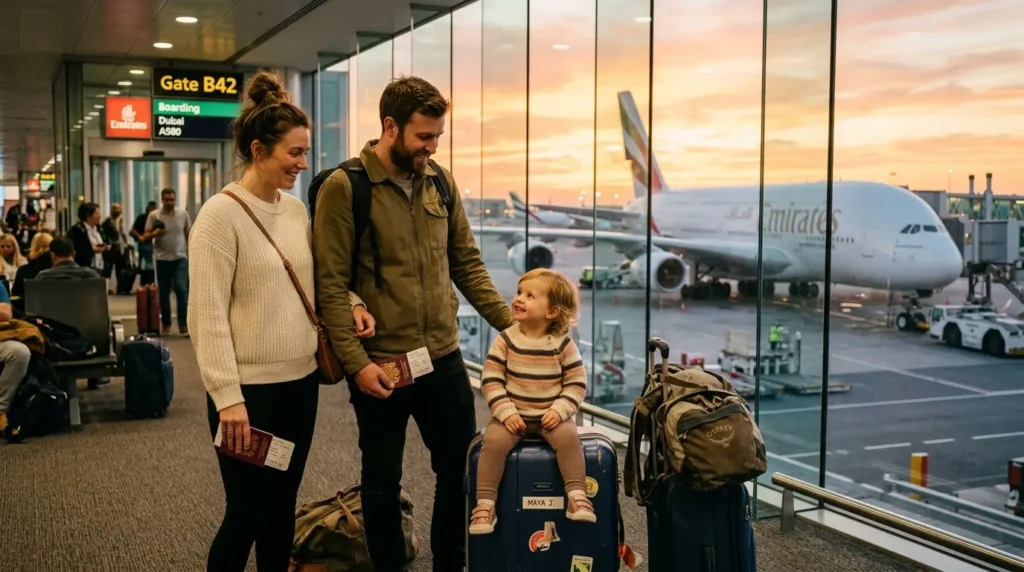
If you are flying for more than 8 hours, then you will have your best chances of your toddler sleeping through a good portion of the flight if he/she leaves late in the day or if it is nighttime! If possible, get off at 7-9 PM. They will eat, relax with some entertainment and hopefully sleep for 5-7 hours in a 10-hour flight.
A midday flight that arrives at the post-lunch nap time can be surprisingly effective in case of shorter long-haul flights (6-8 hours).
Red-eye vs. daytime summary:
| Factor | Red-Eye | Daytime |
|---|---|---|
| Sleep potential | High | Low |
| Entertainment needed | Less | More |
| Toddler mood at departure | Varies | Usually better |
| Jet lag recovery | Faster | Depends on route |
Book the Right Seat Before Someone Else Does
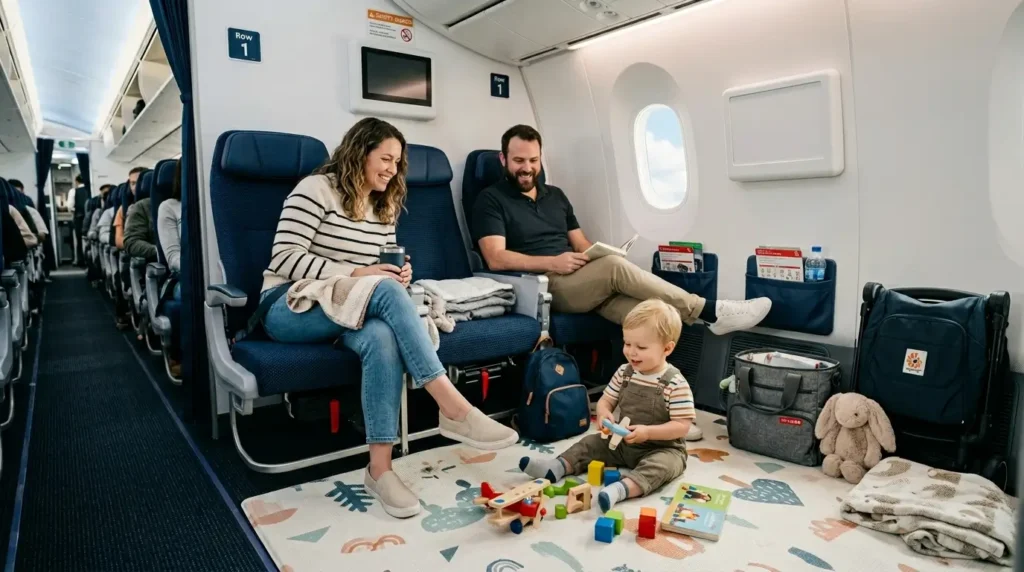
The bulkhead row is the ideal seat for a young child on a plane. It is located at the forward end of each cabin section, provides extra floor space and when your child is under approximately 10 kg (22 lbs), is where the bassinet attaches to the wall. On family-friendly carriers, bulkhead seats sell out quickly. Do this at the ticketing stage, not at the check-in stage.
When you are travelling with a partner and one toddler, choose the window and aisle seat in a 3-across row. Last to book are the seats in the middle of the plane. This way you can frequently find yourself with the empty seat between you for free. When someone books that seat, it will nearly always be swapped for a window or an aisle.
Seats to avoid: the last rows in the cabin (blocked recline, more engine noise, boards last), and any row directly next to the galley (foot traffic, bright lights at night).
Also Read: Last Minute Travel Savings Cheap Flights Last Minute Deals
Bassinets: Book Early and Know the Limits
A bassinet that attaches to the bulkhead wall provides a flat surface for the baby to sleep on (also known as a sky cot). Most airlines have them on their wide-body long-haul aircraft. Weight ranges are carrier-specific and are around 10-12 kg. All major airlines offer them and they are always sold ahead of time, including Emirates, Singapore Airlines and Cathay Pacific.
Please contact the airline directly and not on the app. The availability of bassinet is limited — sometimes there are only two bassinets available for each aircraft — and it is not always clearly available online.
The Airport Phase: Arrive Early, Burn Energy
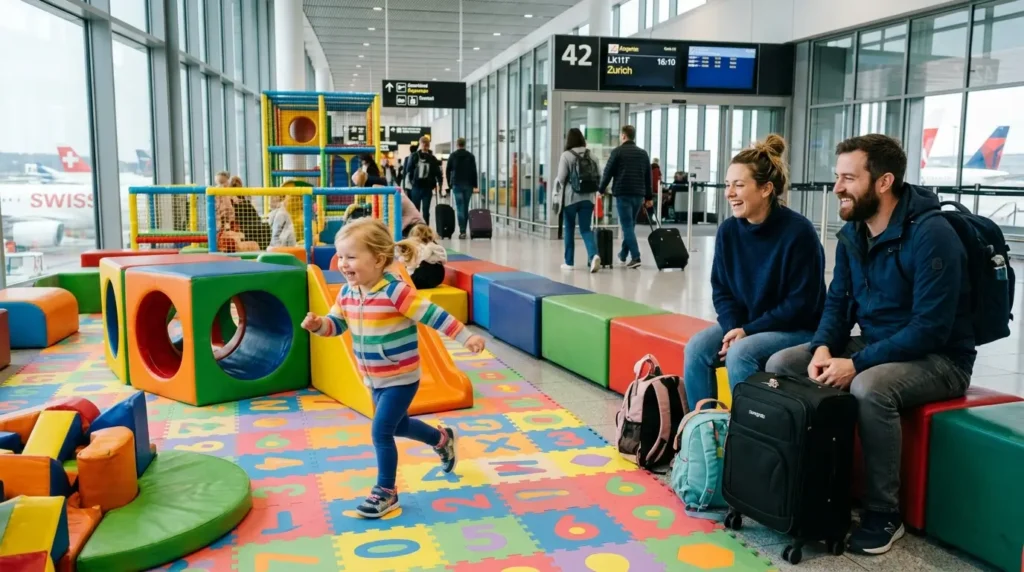
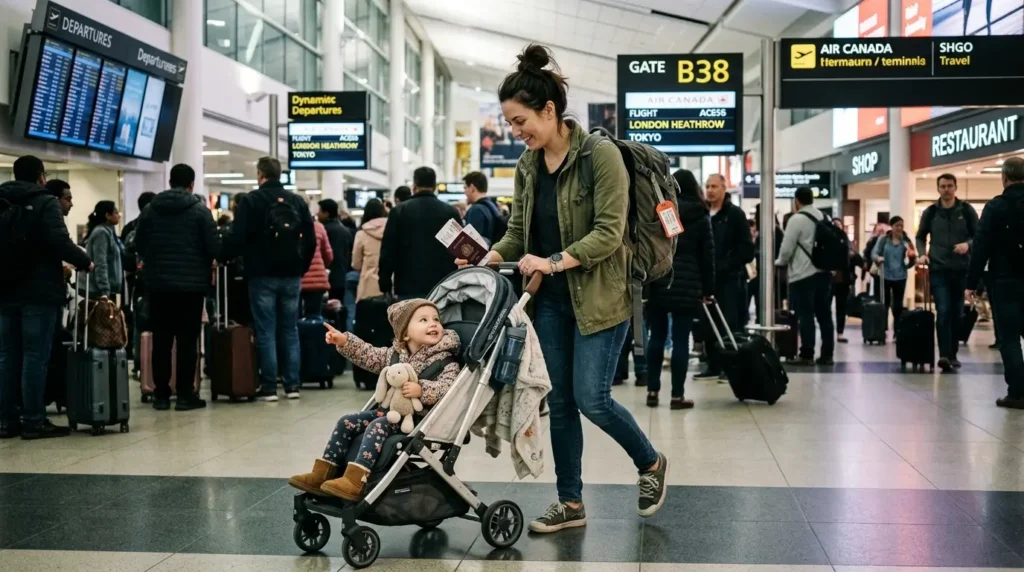
If you have a toddler, make sure to add 45 minutes to your airport arrival time. Not due to the length of check-in (it is long enough), but because you will need to stop for a toilet, and you won’t find the play area until you have already had a snack meltdown at security, and you had to spend an hour getting to the right terminal.
Recommended arrival buffer:
- Domestic: 2.5 hours before departure
- International: 3.5 hours minimum
TSA PreCheck is $78 for five years and is a great deal for family travel if you’re in the United States. No shoes are to be removed, no laptops are to be unpacked and no liquids separated. That alone saves 15 minutes and multiple stress points when you have to deal with a toddler at the same time as you’re running the scanner.
Airport play areas worth knowing:
- In all the terminals at Singapore Changi, you will find play areas, such as the Butterfly Garden
- There are children’s play spaces airside at Amsterdam Schiphol airport
- At Dubai International, there are family zones in Concourse B and C which are devoted to families
- Near Gates B and C, Denver International has playground areas
Use them. Allow your toddler to use up all his energy in running, climbing, playing and jumping before asking him to sit still for 10 hours.
Boarding: Consider Going Last, Not First
Against all the instincts, but it’s true! Most airlines provide family pre-boarding, which would seem very useful, but it is 30-45 minutes of wasted seat time before the aircraft has even pushed back. That’s additional time your toddler spends cooped up, looking at the other passengers as they walk by and bump bags.
A better approach if flying as a couple: one parent can board during family pre-boarding with all the bags, gate-checks the stroller, and claims the seats. The other remains at the terminal until the last boarding call. You get setup time without burning extra in-flight minutes.
If you’re traveling alone, get on the plane during family boarding so that you can get everything set up without the pressure.
Gate-check your stroller at the jet bridge, not the ticket counter. It is required until you get on the aircraft and returns to the jet bridge on arrival.
Takeoff and the Ear Pressure Problem
This is because one of the most common causes of crying while flying is ear pain during ascent or descent, which is often mistaken for a general meltdown. Eustachian tubes of young children are narrower and lie more horizontally than in adults, and thus the pressure equalization is slower and more uncomfortable.
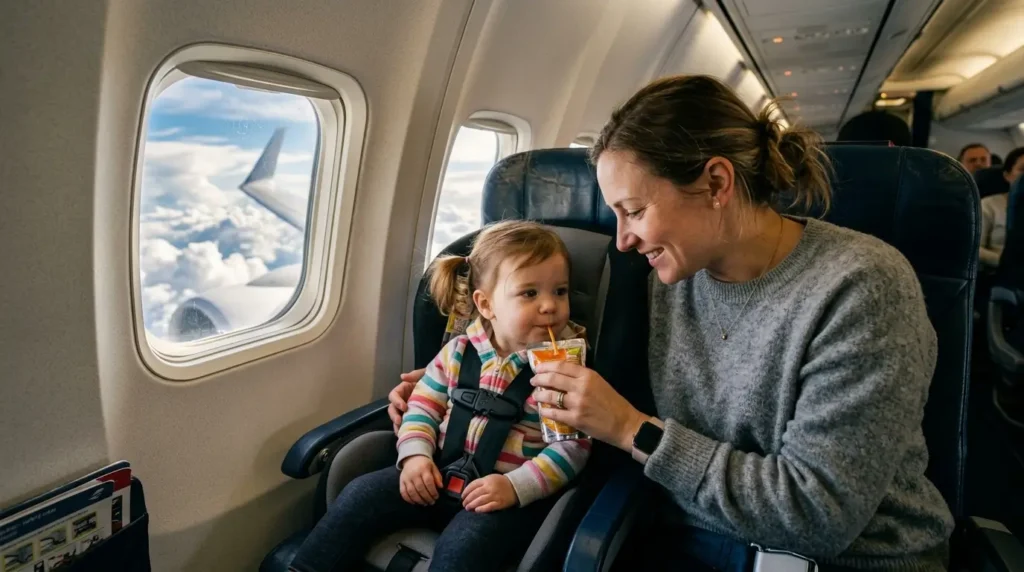
The cure is simple: swallowing. Provide an object for sucking or chewing at takeoff and landing. A bottle, sippy cup with straw, breast, pacifier, snack or lollipop will do. When you swallow, the pressure is released.
EarPlanes children’s ear plugs are pressure-regulating ear plugs which help to diminish the rate of pressure change reaching the eardrum. Most pharmacies in the city and shops in the airports have them for around $8-12. Must have in the bag.
The one rule to keep: if a toddler has an active ear infection, they should not be flown without a pediatrician’s approval. This pressure pain is even worse if there is any fluid present in the middle ear.
What to Pack (and What to Leave Home)
Too much is the most common packing error. The second most common is that it is all revealed at once.
The Carry-On Essentials
Entertainment (in order of when to reveal them):
- 2-3 novelty toys set aside specifically for the flight (new toys buy 20 minutes each)
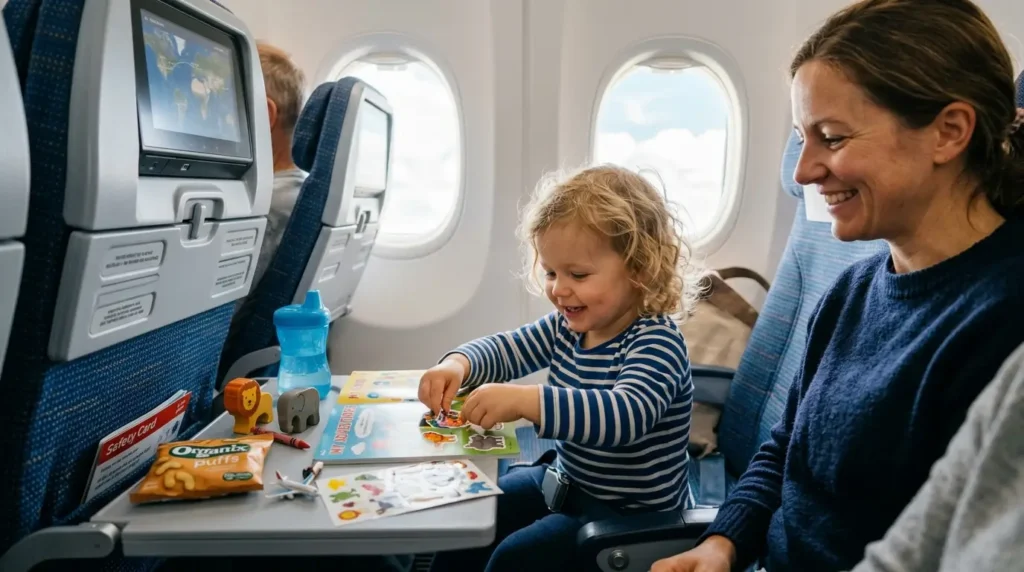
- Absorbing sticker book that is mess-free, and suitable to use from 18 months onwards
- Crayons and coloring pages (triangle crayons don’t roll off the tray table)
- A form of dough that lets your child play with, such as Play-Doh or moldable dough in a sealed container
- Loaded tablet with all content downloaded offline
Also Read: all inclusive resorts for families with kids 2026
Comfort:
- Their home blanket or stuffed animal (must have)
- Toddler-sized travel pillow
- Children’s volume-limiting headphones
- A minimum of 2 sets of clothes (one for them and one for you)
Health:
- Children’s pain reliever (ask your child’s doctor for directions)
- Saline nasal spray (home humidity is 40-60%, but cabin air is 10-20% — toddlers dehydrate more quickly than you realise)
- EarPlanes children’s ear plugs
- Prescribed medication(s) in original container(s)
Snacks:
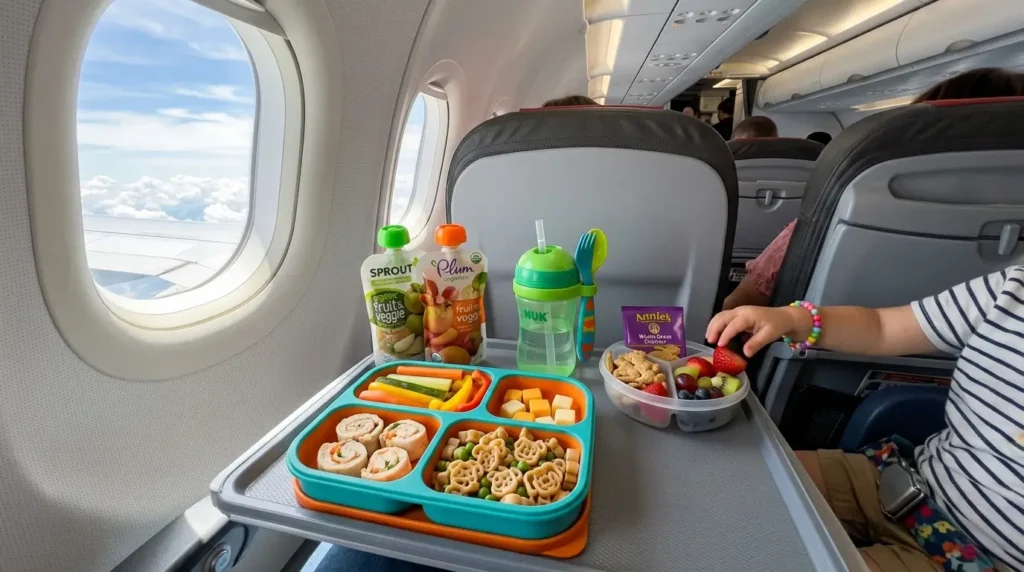
- Squeeze pouches (easy, no mess, good to use during pressure changes)
- Crackers, puffs, dried fruit
- In case of emergencies, one or two special treats kept in reserve
The Entertainment Rotation Method
Do not give everything up in the first hour. Rotate every 20-30 minutes, cycling through:
- New toy #1
- Sticker book
- Tablet (1 x 22-minute episode)
- Snack break
- Window narration (“look at those clouds”)
- New toy #2
- Coloring
- Tablet (interactive app)
- Aisle walk
- Sleep attempt
Once the novelty of one item wears off, you move onto the next. This is what stretches 6 hours of material across a 10-hour flight.
Apps worth downloading offline:
- YouTube Kids (download playlists ahead of time)
- Khan Academy Kids
- Endless Alphabet
- Toca Boca series
Toddler entertainment shouldn’t be done via in-flight Wi-Fi. It is slow, costly and cuts out during the moments you need it most.
What Is the 3-3-3 Rule for Flying with Toddlers?
Plan three activities, three snacks and three short walks throughout the flight. You space them out in thirds rather than offering everything in the first two hours. It helps to maintain engagement without consuming all of your kit before the halfway point.
It is not a system that is set in stone. It’s a reminder to take it easy.
Getting Your Toddler to Sleep on the Flight
The largest variation is sleep. One hour of toddler napping equals one hour of relaxation for you.
Recreate the Bedtime Environment
This is the approach that works. If you cue your toddler appropriately, they won’t know that they’re on a plane.
- Place them in sleepwear or sleep clothes before or at boarding time
- Grab their blanket and cuddle toy
- Close the window shade
- Play their regular sleep music or white noise through their headphones
- Do a version of whatever pre-sleep ritual you use at home (a short story, a song)
The noise of the aircraft engine, in fact, helps. It is consistent and low in frequency, close to white noise.
Sleep Surface Options
Toddlers do better sleeping lying flat. Options:
- Bassinet — suitable for lighter children weighing less than 10-12 kg; attach to bulkhead wall
- JetKids BedBox — a ride-on suitcase designed to make a flat surface in the footwell (approx $150-200), which works on most aircraft, but do check airline policy first
- Fly LegsUp — a hammock-style footrest that is designed to provide a similar flat surface
- Across two seats — if you have extra space, let your toddler stretch across with their head in your lap
Please check airline regulations for footrest devices before traveling. Some carriers allow them and others don’t. Even routes operated by the same airline can have different policies.
Snacks and Hydration at 35,000 Feet
Pre-order the children’s meal if your airline offers it. Most international carriers do and it can be arranged 24-72 hours before the flight, via the booking management portal. Children’s meals are presented before the main meal, are limited in complexity and are more likely to be eaten by your toddler. Don’t forget to bring your own food with you just in case.
Offer sips every 30-45 minutes. Toddlers sometimes do not show their thirst as clearly and at altitude, the air is drier, causing toddlers to dry out more quickly. Coconut water packets and diluted juice can help reluctant drinkers.
Don’t feed your toddler if he falls asleep at mealtimes. Sleep is worth more.
Handling a Meltdown Mid-Air
This is likely to occur. Most of the other passengers will be as tolerant as you fear, especially parents. Here is what actually helps:
Prevention first:
| Trigger | Prevention |
|---|---|
| Hunger | Snack every 60-90 minutes |
| Boredom | New activities; never dump everything at once |
| Ear pain | Offer food or suck during pressure changes |
| Overtiredness | Protect the nap window |
| Confinement | Aisle walk every 90-120 minutes |
When a meltdown starts:
- Stay calm. Your escalation makes their escalation worse.
- Move to the rear galley if you can get out of the seat.
- Use a low, steady voice.
- Give a comforting object or offer the emergency snack you held back.
- Offer a small choice: “Do you want the red crayon or the blue one?” Control reduces distress.
- Redirect immediately once calm returns.
Do not try to reason with a toddler at peak meltdown. It does not work. Be patient and then refocus.
Safety: Car Seats, CARES Harness, and Lap Infants
The FAA recommends that children under 40 lbs be in an approved restraint for use in aircraft. When your child is given “lap infant” status, it means that during turbulence your child is not properly restrained. Turbulence is the most common reason for child injuries aboard aircraft.
Two good options:
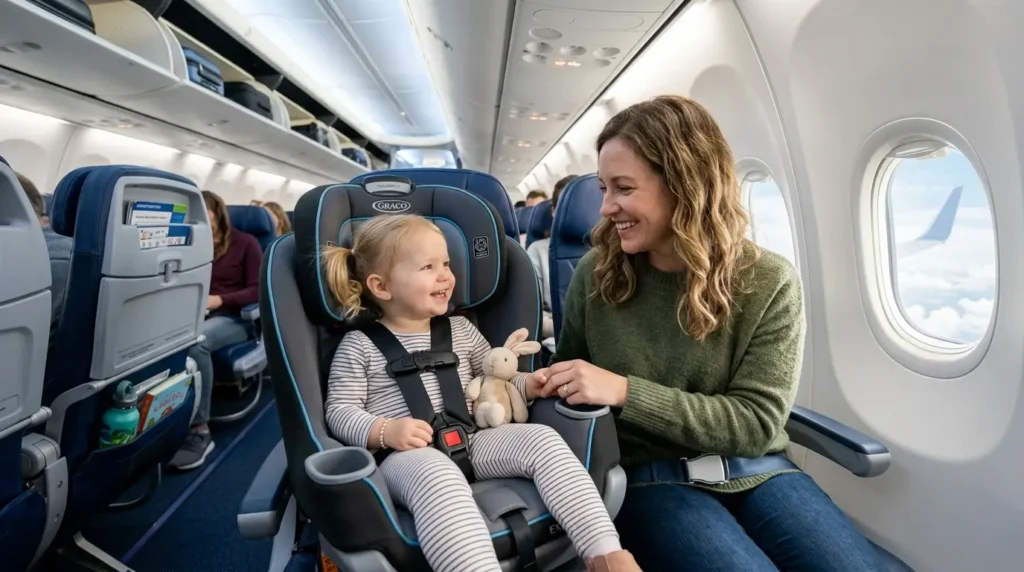
FAA-approved car seat: Can be used in a purchased seat. Requires the FAA approval label (typically on the back or side of the product). Most standard car seats meet the requirements. A rolling car seat cart allows you to easily push it through the airport instead of carrying it.
CARES Harness: A 1 lb harness that attaches to the seatback. Approved by the FAA for children 22-44 lbs. A 4-point restraint and much more convenient for traveling. Around $80-100. For the family who flies on a regular basis, the CARES harness is the one to have.
Booster seats and backless car seats are not allowed during takeoff, landing or ground movement.
The fares for lap infants on international flights are usually approx. 10% of the adult fare. On long-haul routes, children in their own seat typically pay 75% of the adult ticket price.
Tips by Toddler Age
Some toddlers fly better than others. The toolkit changes as one grows older.
12-18 months: The hardest phase. Mobile, curious and no concept of “sit still”. If weight allows, book a bassinet. A baby carrier works for aisle walks. Activity windows are brief — 5-10 minutes per window. Feeding on takeoff and landing is a must.
18 months – 2 years: Tablet content becomes usable. The novelty strategy with regard to new toys is working. Move around the aisle every 60-90 minutes. Give snacks every 45 minutes.
2-3 years: A significant change in manageability. Sustained attention improves. Is able to follow simple instructions. Tell them the story as you fly (“we’re flying over the ocean”). Have them prepare a small backpack before the trip, so they will feel a sense of ownership over it.
3+ years: With suitable preparation, most 3-year-olds are able to manage 8 hours. They know that they are “almost there.” Can play simple games (I Spy, counting games). The toolkit is much more comprehensive.
Solo Parent Long-Haul: The Specific Challenges
Traveling alone with a toddler can be challenging, and there is little online advice that deals with it directly.
Some points to make it easier:
- Book the aisle seat, not the window. You’ll need quick access for bathroom runs.
- Ask crew early if they can keep an eye on your child for 2 minutes while you use the lavatory. Most will, and it is not an intrusion to ask.
- Bring a travel backpack, not a rolling carry-on. Both hands need to be free.
- Pack all that you need in the top layer of the bag for the first 30 minutes so you will not need to excavate the bag while managing a toddler.
- Be okay with the fact that the flight will be more challenging compared to having another parent, and plan accordingly rather than packing as if you have backup.
When Not to Fly
There are some cases where it is advisable to postpone:
- Active ear infection: Real pain, as with inflamed middle ear fluid during a flight with pressure changes
- High fever within 24 hours of departure
- Active respiratory infection that affects ear pressure equalization
If in any doubt, always consult a child’s doctor. The majority of them are used to this question prior to family vacations.
What Is the Best Age to Fly Long-Haul with a Toddler?
The best age is not determined; it depends on the child. A lot of parents have discovered that 3+ is easier for them than 12-24 months, as older toddlers can use the screen, follow instructions and communicate better. However, with proper preparation, even a 14-month-old can fly well. It’s more about the child and the preparation than it is about age.
Should I Buy a Seat for My 18-Month-Old?
The FAA recommends it for safety. The lap infant option is more affordable, but does not keep your baby safe during rough air. The CARES harness is an affordable and secure choice for a child weighing more than 22 lbs, if the seat is affordable.
What Is the Best Seat for a Toddler on a Plane?
The bulkhead row. It provides additional floor space, access to the bassinet for smaller children, good aisle access and no seatback for your toddler to kick in front. The trade-off is that you will never be able to store things under the seat, and the tray tables are stored in the armrest.
What Helps Toddler Ear Pain on a Plane?
Encourage swallowing during takeoff and landing. Provide a bottle, breast, sippy cup with a straw, pacifier, or lollipop. The swallowing action equalizes pressure through the Eustachian tube. EarPlanes children’s ear plugs also slow down the rate of pressure change. Do not fly with an active ear infection that hasn’t been cleared by a doctor.
Are Inflatable Footrests Allowed on Planes for Toddlers?
This will be subject to the airline’s and/or crew’s discretion. Carriers vary when it comes to what products can be used, such as the JetKids BedBox and Fly LegsUp. Certain airlines will permit them except during takeoff and landing. Before traveling, always review the specific airline’s policy, and be prepared to stow it if asked.
How Early Should I Arrive at the Airport with a Toddler?
Add an extra 30-45 minutes to whatever you’d normally plan. If you’re travelling internationally, the goal is to be there 3.5 hours prior. You will use that time, and the buffer means there will be less stress which translates directly to your toddler’s stress.
What Is the 3-3-3 Rule for Flying with Toddlers?
Three activities, three snacks, three short aisle walks — spread across the flight in thirds, rather than all at once. This is a pacing framework, not a strict schedule. The idea is to not burn through everything in the first two hours.
Can a 2-Year-Old Use a CARES Harness?
Yes, if they have their own purchased seat and weigh between 22 and 44 lbs. The CARES harness is FAA-approved and provides a 4-point restraint. It weighs approximately 1 lb and comes in a small bag, which makes it much easier to travel with than a full car seat.
Do Toddlers Need a Passport for International Flights?
Yes. International travel requires passports for passengers of all ages. For domestic flights, requirements differ according to country and airline. ID is not required for travel within the United States when traveling with children under the age of 18; however, their name on the boarding pass must be the same as their legal name.
What Snacks Should I Bring for a Toddler on a Long Flight?
Take familiar snacks that your toddler already reliably eats, such as squeeze pouches, crackers, puffs, dried mango, cheese sticks, or dried fruit. Keep one or two special treats for really challenging times. Offer something to eat or drink every 60-90 minutes. Dry cabin air causes dehydration and can have a marked impact on mood and behavior.